
Understanding business energy bills can feel confusing. Most people only check the total amount and ignore the extra charges. Two important costs on your bill are VAT and Climate Change Levy (CCL). Many businesses overpay because they don’t understand these charges or miss possible discounts. This can increase your overall energy costs without you realizing it.If you understand Business Gas VAT & CCL, you can check your bill properly and avoid paying more than necessary. In this guide, you will learn what these charges are, current rates, and simple ways to reduce your business gas costs.
What is VAT on Business Gas?
Value Added Tax applies to most goods and services in the UK, and commercial energy is no exception. When your supplier bills you for the gas you consume, they must add VAT to the total cost. The government sets this tax, and suppliers act as the collection agent, passing the funds directly to HM Revenue & Customs (HMRC).
Unlike domestic energy, which automatically receives a lower tax rate, commercial gas is treated differently. The rate you pay depends heavily on how much energy your company uses and the nature of your business operations.
Standard VAT Rate for Business Gas
The standard VAT rate for business gas in the UK is 20%. If your company uses a moderate to high amount of energy for standard commercial operations, you will typically pay this rate. Most corporate offices, large retail stores, and manufacturing facilities fall into this bracket by default.
Suppliers will automatically apply this 20% charge unless you actively prove you are eligible for a reduction. You cannot avoid this standard rate if your usage exceeds the government’s low-usage threshold.
Reduced VAT Rate (5%) – Who Qualifies?
Some businesses do not have to pay the full 20%. Instead, they qualify for a reduced VAT rate of just 5%.
To get this lower rate, your business must meet specific criteria. For instance, if you use a very low amount of gas, you automatically qualify for the 5% rate.
Additionally, charities and non-profit organisations often qualify for this reduction. If a building is used mostly for residential purposes, it might also get the lower rate.
How VAT is Calculated on Gas Bills
Suppliers calculate VAT based on the total cost of your energy consumption plus your standing charge. They take the amount of gas you used, multiply it by your unit rate, add the daily standing charges for the billing period, and then calculate the 20% or 5% tax on that final sum.
Any other levies or fees on the bill, including the Climate Change Levy, are also subject to VAT. This essentially means you are paying a tax on a tax.
What is Climate Change Levy (CCL)?
The Climate Change Levy is an environmental tax introduced by the UK government in 2001. It targets commercial users of energy, including gas, electricity, and solid fuels.
While VAT is a general consumption tax, the CCL has a highly specific environmental focus. It forms a core part of the UK’s strategy to reduce carbon emissions and meet global climate commitments.
Purpose of CCL
The primary goal of the CCL is to encourage businesses to become more energy-efficient. By taxing the volume of energy consumed, the government creates a financial incentive for companies to reduce their carbon footprint.
The funds collected through this levy help support nationwide environmental initiatives and renewable energy projects. By making heavy energy usage more expensive, the government hopes companies will invest in better insulation, smarter heating systems, and green technologies.
Current CCL Rates for Gas
Unlike VAT, which is a percentage of your total cost, the CCL is a flat rate applied to every single unit of energy you consume. The government reviews and adjusts these rates annually.
For the 2023/2024 financial year, the main rate of CCL for gas is 0.00775 pounds per kilowatt-hour (kWh). While a fraction of a penny might seem insignificant, it adds up rapidly for heavy industrial users running large boilers or heating massive warehouses around the clock.
Who Needs to Pay CCL?
Any business operating in the industrial, commercial, agricultural, or public service sectors must pay the CCL. If you pay the standard 20% VAT rate on your business gas, you will automatically be charged the Climate Change Levy.
Only organizations that qualify for specific exemptions or the reduced VAT rate can legally avoid paying this environmental tax.
Difference Between VAT and CCL
Because both VAT and CCL appear on the final summary of a commercial energy bill, they are often confused. Understanding how they differ helps you audit your invoices properly.
Key Differences Explained
Understanding the difference between VAT and CCL is important because both charges affect your business gas bill in different ways.
VAT (Value Added Tax)
- VAT is a percentage-based tax on your total bill
- If energy prices increase, VAT also increases
- You may pay more VAT even if usage stays the same
CCL (Climate Change Levy)
- CCL is based on actual energy usage (kWh)
- It is an environmental tax
- Market price changes do NOT affect CCL
- You only pay more CCL if you use more gas
Why Both Charges Appear on Your Bill
Your supplier is legally required to collect both taxes on behalf of the government. The CCL is applied first, based on your total kWh consumption. Afterward, the VAT is calculated based on the total financial cost of your gas, your standing charge, and the CCL combined. They serve entirely different legislative purposes, which is why neither cancels the other out.
Who is Exempt from VAT and CCL?
Not every organization has to pay the standard tax rates. The government provides several exemptions to protect specific sectors and small enterprises from excessive financial strain.
Charities and Non-Profit Organisations
Charitable organizations receive significant tax relief on their energy bills. If an entity is a registered charity and uses its premises for non-business purposes, it qualifies for the 5% reduced VAT rate. Because they qualify for the 5% VAT rate, they are also entirely exempt from paying the Climate Change Levy.
Low Energy Usage Businesses
Small businesses that consume very little gas are protected under the de minimis rule. If a company uses less than 4,397 kWh of gas per month, they automatically receive the 5% VAT rate. Consequently, this low usage also grants them a full exemption from the CCL. This rule heavily benefits small retail units, independent cafes, and micro-businesses.
Mixed-Use Properties
Sometimes a property serves both commercial and domestic purposes. A common example is a pub with a residential flat located on the floor above. If a single gas meter supplies the entire building, the business can claim a mixed-use exemption.
If at least 60% of the energy is used for domestic purposes, the entire bill qualifies for the 5% VAT rate and zero CCL. If the domestic usage is less than 60%, the supplier will apportion the bill. They will charge 5% VAT on the domestic portion and 20% VAT on the commercial portion.
How to Reduce Business Gas VAT & CCL Costs
You do not have to accept high tax bills as a permanent reality. There are several proactive steps you can take to lower these charges legally.
Applying for VAT Reduction
Suppliers do not always know the specifics of your business operations. If you are a charity or run a mixed-use property, you must inform your provider. You can also learn how different business categories affect VAT eligibility in our guide on Micro vs Small Business Gas. You do this by submitting a VAT declaration form, often called a VAT certificate. Once processed, the supplier will adjust your billing to the 5% rate. In many cases, you can also claim back overpaid VAT for the past four years.
Claiming CCL Exemptions
If your business operates in an energy-intensive industry, such as manufacturing or agriculture, you might be eligible for a Climate Change Agreement (CCA). By signing a CCA, your business agrees to meet strict energy efficiency targets. In return, you receive a substantial discount on the CCL—often up to an 88% reduction on your gas levy.
Switching to Energy-Efficient Solutions
Because the CCL is tied directly to consumption, the most foolproof way to reduce this tax is to use less gas. Upgrading to a highly efficient condensing boiler can drastically lower your monthly kWh usage. Installing smart thermostats ensures heating is only used when absolutely necessary. By driving your consumption down, you might even drop below the de minimis threshold, unlocking the 5% VAT rate and eliminating your CCL entirely.
Impact of VAT & CCL on Business Energy Bills
Taxes form a substantial chunk of your overall energy expenditure. Visualizing this impact helps highlight the importance of accurate billing.
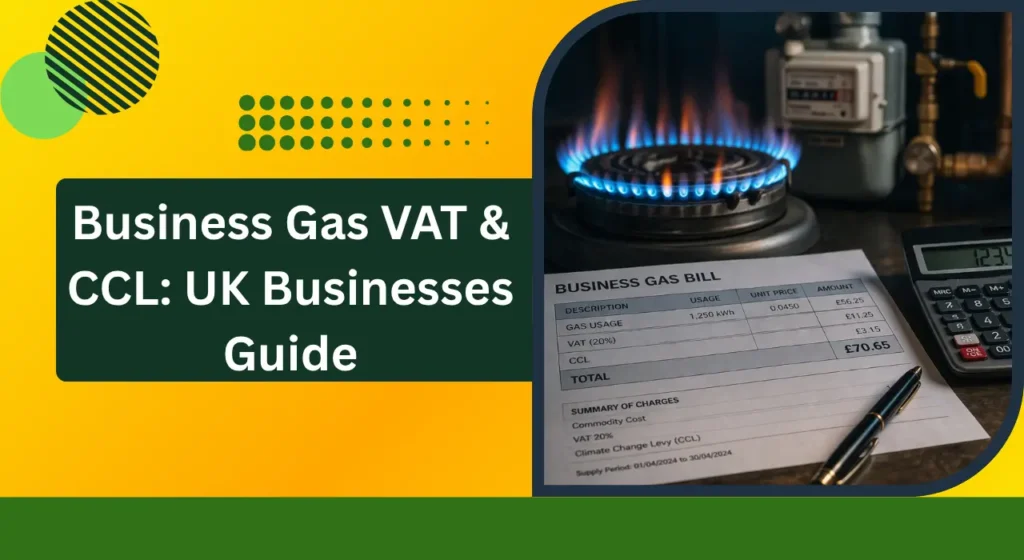
Cost Breakdown Example
Consider a mid-sized office paying a total gas cost of £1,000 before taxes, having consumed 20,000 kWh of gas in a month.
First, the supplier calculates the CCL. At a rate of roughly 0.00775p per kWh, the CCL adds £155 to the bill.
The new subtotal is £1,155.
Next, the standard 20% VAT is applied to this subtotal, adding £231.
The final bill becomes £1,386. Taxes alone added £386 to the original energy cost.
How It Affects Small vs Large Businesses
For large industrial firms, the CCL represents a massive financial burden due to their high consumption. They often have dedicated energy managers focused entirely on securing CCAs and driving down usage.
For small businesses, the challenge is different. Many small companies hover right around the de minimis threshold. A slightly colder winter can push their usage above 4,397 kWh for a given month, suddenly triggering the 20% VAT rate and the addition of the CCL, causing an unexpected spike in operating costs.
Key Things to Check on Your Gas Bill
Auditing your own invoices is the best defense against overpaying. You should check your gas bill every month to ensure the charges are accurate.
Identifying VAT Charges
Look for the summary section on the first or second page of your invoice. The VAT charge should be listed clearly as a separate line item. Check the percentage rate applied. If you see 20% but believe you qualify for the 5% rate, you need to contact your supplier immediately.
Spotting CCL on Your Invoice
The CCL will also have its own dedicated line in the breakdown of charges. It usually sits right below your unit charges and standing charges, just before the VAT is calculated. Ensure this line reads zero if your usage for the month fell below the 4,397 kWh threshold.
Common Billing Mistakes
The most frequent error occurs when a supplier overestimates a meter reading. If an estimated read pushes your assumed usage above the de minimis threshold, you will be wrongfully charged 20% VAT and CCL. Submitting regular, accurate meter readings or installing a smart meter prevents this costly mistake.
Is Business Gas VAT & CCL Changing in the Future?
The landscape of energy taxation is continually shifting as the UK pursues its net-zero emissions targets. The government has historically increased the CCL rates for gas to align them more closely with electricity rates. This policy aims to discourage the use of fossil fuels and push companies toward electrification and renewable energy sources.
While VAT rates are generally stable, you should expect CCL costs to rise over the coming years. Businesses that fail to prioritize energy efficiency will face increasingly heavy financial penalties through these environmental levies.
Conclusion
Understanding Business Gas VAT & CCL is essential for managing your energy costs effectively. Many businesses unknowingly overpay due to incorrect rates or missed exemptions. By knowing how VAT and CCL work, you can check your bills, claim eligible reductions, and avoid unnecessary charges. Taking simple steps like monitoring usage, applying for the correct VAT rate, and improving energy efficiency can significantly reduce your overall costs. In the long run, better awareness means better control over your business energy expenses.
FAQs About Business Gas VAT & CCL
Here are some common questions businesses often ask about VAT and CCL:
1. Do all businesses pay 20% VAT on gas?
No, not all businesses pay 20%. Some qualify for a reduced 5% VAT rate, such as low-usage businesses, charities, and certain mixed-use properties.
2. What is the Climate Change Levy (CCL)?
CCL is an environmental tax charged on business energy usage. It is based on how much gas (kWh) you consume, not the price.
3. Can I avoid paying CCL on my gas bill?
Yes, you can avoid CCL if you qualify for exemptions, such as low energy usage or if your business is a charity. Some businesses can also get discounts through Climate Change Agreements (CCA).
4. How can I reduce VAT and CCL costs on my gas bill?
You can reduce costs by applying for the correct VAT rate, improving energy efficiency, lowering gas usage, and ensuring your bills are accurate.