
Understanding business gas contract terms UK is essential for every UK business owner. These contracts include key elements such as unit rates, standing charges, tariffs, and VAT, all of which directly impact your energy costs and budgeting. By understanding the key terms in a business gas contract, businesses can avoid hidden charges and choose the most cost-effective energy deal.
By knowing these key terms in a business gas contract, you can make informed decisions, avoid hidden charges, and ensure your business has a reliable and cost-effective gas supply.
Key Terms to Understand in a Business Gas Contract
Energy contracts are often filled with industry jargon. Breaking down these terms makes it much easier to know exactly what you are paying for.
Supply Start Date
This is the specific date your new gas supplier officially takes over your energy provision. If you are switching from another provider, the supply start date usually aligns with the end of your previous contract. Keeping track of this date ensures you avoid being rolled onto expensive out-of-contract rates by your old supplier.
Contract Duration
Business gas contracts typically last anywhere from one to five years. The contract duration specifies exactly how long you are locked into the agreed-upon rates. You must also pay attention to the renewal options. Many suppliers require a termination notice a few months before the contract ends; otherwise, they may automatically renew your agreement at a less favorable rate.
Unit Rate
The unit rate is the price you pay for the actual gas your business consumes. It is measured in kilowatt-hours (kWh). Depending on your business size and energy habits, even a fraction of a penny difference in the unit rate can result in massive savings or losses over a year.
Standing Charges
Alongside the unit rate, suppliers apply a standing charge. This is a fixed daily or monthly fee that covers the cost of maintaining the gas network, reading your meter, and keeping your account active. You have to pay the standing charge regardless of how much gas you actually use.
You can also learn more in our Business Gas Standing Charges Explained.
Payment Terms
Your contract will clearly state the billing frequency (monthly or quarterly) and the accepted payment methods. Most suppliers prefer Direct Debit and often offer discounts for customers who choose this automated payment method. Late payments can result in extra charges or a negative impact on your business credit score.
Exit Fees / Termination Charges
If you decide to leave your contract before the agreed end date, your supplier will likely charge an exit fee. These termination charges can be exceptionally high, often calculated based on the estimated energy you would have used for the remainder of the contract. Always check this clause before signing.
Tariff Type
Gas contracts usually come in three formats: fixed, variable, or flexible. A fixed tariff locks your unit rate in for the duration of the contract, protecting you from market price spikes. A variable tariff means your rates will fluctuate based on wholesale energy costs. Flexible contracts allow large businesses to buy their gas in chunks throughout the year, taking advantage of market dips.
To better understand tariff types, read our Fixed vs Variable Tariff: Which is Best for You?
Consumption Forecast
Suppliers calculate your rates based on your estimated gas usage, known as a consumption forecast. If your business uses significantly more or less gas than forecasted, some contracts include volume tolerance clauses that penalize you for the variance. Accurate forecasting is vital to avoid these unexpected penalties.
VAT and Other Taxes
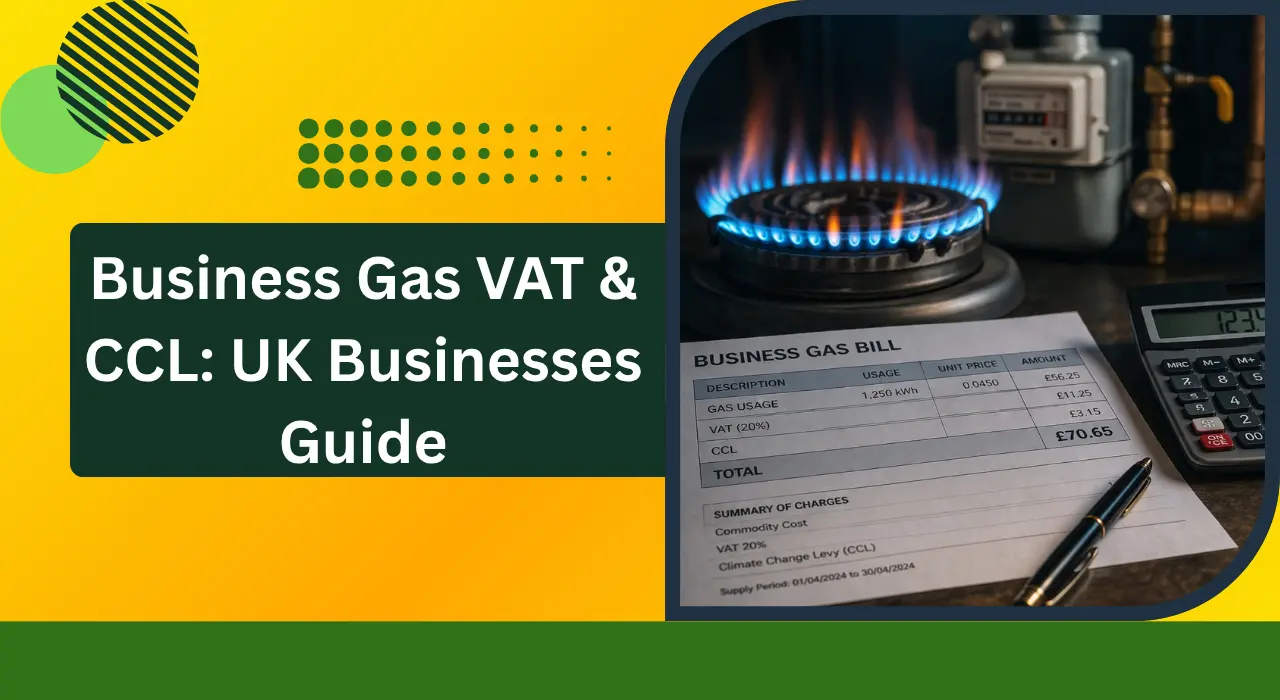
Taxes make up a notable portion of your commercial energy bill. The standard Value Added Tax (VAT) rate for business energy is 20%. However, if your business uses a low amount of energy (known as the de minimis threshold) or operates as a charity, you might qualify for a reduced VAT rate of 5%.
Additionally, businesses must pay the Climate Change Levy (CCL). The CCL is an environmental tax designed to encourage companies to become more energy-efficient and reduce their carbon footprint. If you pay the reduced 5% VAT rate, you are automatically exempt from the CCL. You can also gain CCL exemptions by using renewable energy or participating in a Climate Change Agreement (CCA).
Supplier Terms & Conditions
The terms and conditions section outlines the legal obligations of both you and the supplier. It covers meter access rights, data protection protocols, and what happens if either party breaches the contract. Reading this section protects your business from predatory supplier practices.
Dispute Resolution
If you ever have a disagreement with your supplier regarding billing errors or service interruptions, the dispute resolution clause dictates the process for handling it. It explains how to lodge a formal complaint and when you can escalate the issue to an independent energy ombudsman. According to Ofgem, businesses can escalate unresolved disputes to an independent energy ombudsman.
How to Compare Business Gas Contracts
Finding the right deal requires a careful evaluation of multiple suppliers. Start by gathering your current energy bills so you know your exact annual consumption.
Next, request quotes from several different suppliers. Do not just look at the unit rate. To compare market rates, read our latest Average Business Gas Prices UK: Latest Rates & Cost Guide (2026). A supplier might offer a cheap unit rate but make up for it with an excessively high daily standing charge. Calculate the total estimated annual cost by combining your forecasted usage with the quoted unit rate, then add the total standing charges for the year.
You should also research the supplier’s reputation. Look at online reviews and customer service ratings. A slightly cheaper bill is rarely worth the headache of dealing with a supplier that has terrible billing accuracy or unreachable customer support.
Finally, check the fine print for volume tolerance limits and exit fees. Ensure the contract terms offer the flexibility your business might need if you plan to scale up operations or move locations.
Choosing the Right Contract for Your Business
Selecting the ideal contract depends entirely on your business model, size, and risk tolerance.
Small to medium-sized enterprises (SMEs) generally benefit the most from fixed-rate contracts. Knowing exactly how much you will pay for gas each month provides financial stability and makes budgeting straightforward.
If you run a seasonal business, such as a summer resort or a winter heating service, pay close attention to your consumption forecast. You will want a contract that allows for high variations in energy use without triggering volume penalties.
Large industrial businesses with dedicated energy managers might prefer flexible purchasing contracts. These allow companies to buy energy directly from the wholesale market, taking advantage of price drops to secure massive savings. However, this approach requires close market monitoring and carries a higher risk.
Always ensure your tax status is correctly applied. If you qualify for the 5% VAT rate and the CCL exemption, verify that your supplier has the correct declaration forms on file before the contract begins.
Conclusion
Being aware of the key terms in a business gas contract allows businesses to manage energy expenses more effectively. A careful review of contract details helps you select the right tariff, plan your budget accurately, and avoid unexpected costs. Whether your business is small, medium, or large, understanding important terms like unit rates, standing charges, and exit fees ensures smooth operations and financial control. Choosing the right contract isn’t just about saving money—it’s about running your business confidently and efficiently.
FAQs
Many UK business owners often have questions about the key terms in a business gas contract. Here are some of the most common queries:
What is a unit rate in a business gas contract?
The unit rate is the cost you pay for each kilowatt-hour (kWh) of gas. It can be fixed or variable depending on the contract type. Knowing the unit rate is crucial to accurately forecast your energy expenses.
What are standing charges in a business gas contract?
Standing charges are fixed daily or monthly fees that cover the cost of maintaining your gas supply, regardless of usage. These charges are separate from the unit rate and are included in your monthly bill.
Can I terminate a business gas contract early?
Most contracts allow early termination, but they usually include exit fees or penalties. Understanding this key term in a business gas contract can save you from unexpected costs.
How do I choose the best gas contract for my business?
Consider contract length, unit rates, standing charges, and estimated consumption. Comparing multiple suppliers and reviewing the key terms in a business gas contract helps you choose the most cost-effective and suitable option for your business needs.